
Thursday, February 26, 1:00 - 5:30 pm (EST)
Teleconference Lecture Hall
Alexander Library, Rutgers University
169 College Ave
New Brunswick, NJ 08901
This in-person event is free and open to the public.
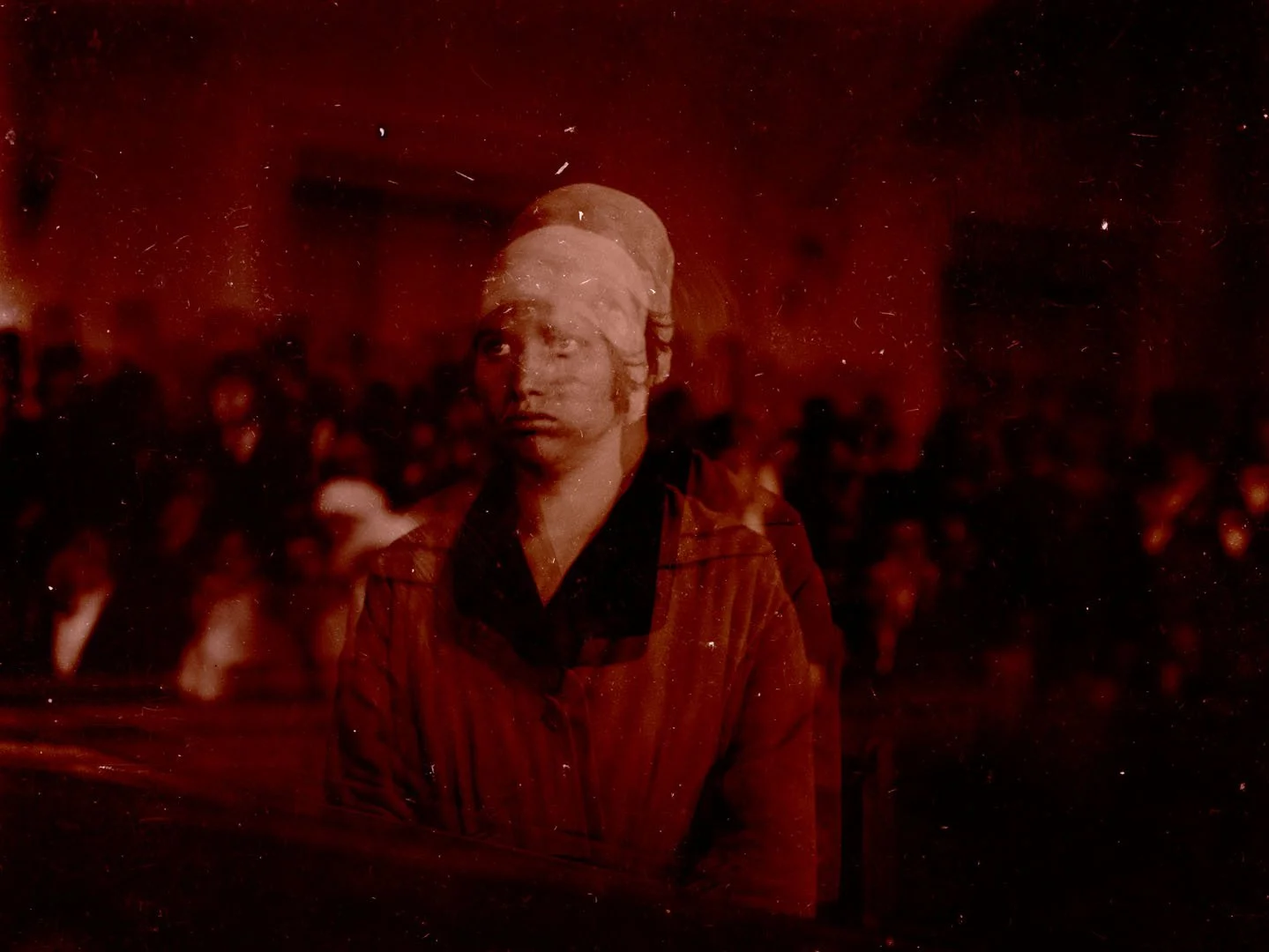
Unidentified courtroom photograph. İstanbul Research Institute Photography Archive.
The last ten years have seen a burgeoning interest in the photography of the late Ottoman Empire and the early Turkish Republic. In these decades, the Sultan embraced the medium as a means to disseminate images of his quickly modernizing realm and to catalogue its dissidents, while popular periodicals printed copious amounts of photographic reportage, much as was being done in Western Europe. The first decade of the Republic then saw a further explosion of this popular visual culture in the press, while portrait studios flourished more than ever. Investigations into this copious amount of material have revealed a thriving and multidimensional photographic culture that had yet to be critically digested. Our symposium takes stock of this new scholarship and explores new directions. It features presentations by senior academics and emerging scholars, and responses from specialists in the field. To borrow a term from the recent book, we will ask what defined the Camera Ottomana and whether this very nomenclature is too totalizing.
The event is free and open to the public.
Sponsors
Center for Cultural Analysis
Islam, the Humanities and the Human
Art History Department (Rutgers, New Brunswick)
Arts, Culture and Media Department (Rutgers, Newark)
Department of Anthropology (Rutgers, New Brunswick)
The Rutgers Art History Graduate Student Organization (AHSO)
The Rutgers Graduate Student Association (GSA)
Schedule
1:00: Introduction - Andrés Mario Zervigón
1:15: Keynote Talk - Ahmet Ersoy
1:45: Response and Discussion: Deniz Türker
Panel One: 2:15 - 3:15 pm EST
Erin Hyde Nolan
Furkan Sarılıcan
Berin Gölönü
Response and Discussion: 3:15 - 3:45
Gülru Çakmak
Coffee break: 3:45 - 4:15
Panel Two: 4:15 - 5:00 EST
Zeynep Gürsel
Selin Aran
Response, Discussion, and Closing Words: 5:00 - 5:30
Alex Seggerman
Keynote talk
Ahmet Ersoy, Boğaziçi University
Data Dump Istanbul: Early Republican Photojournalism and archival refuse
ABSTRACT
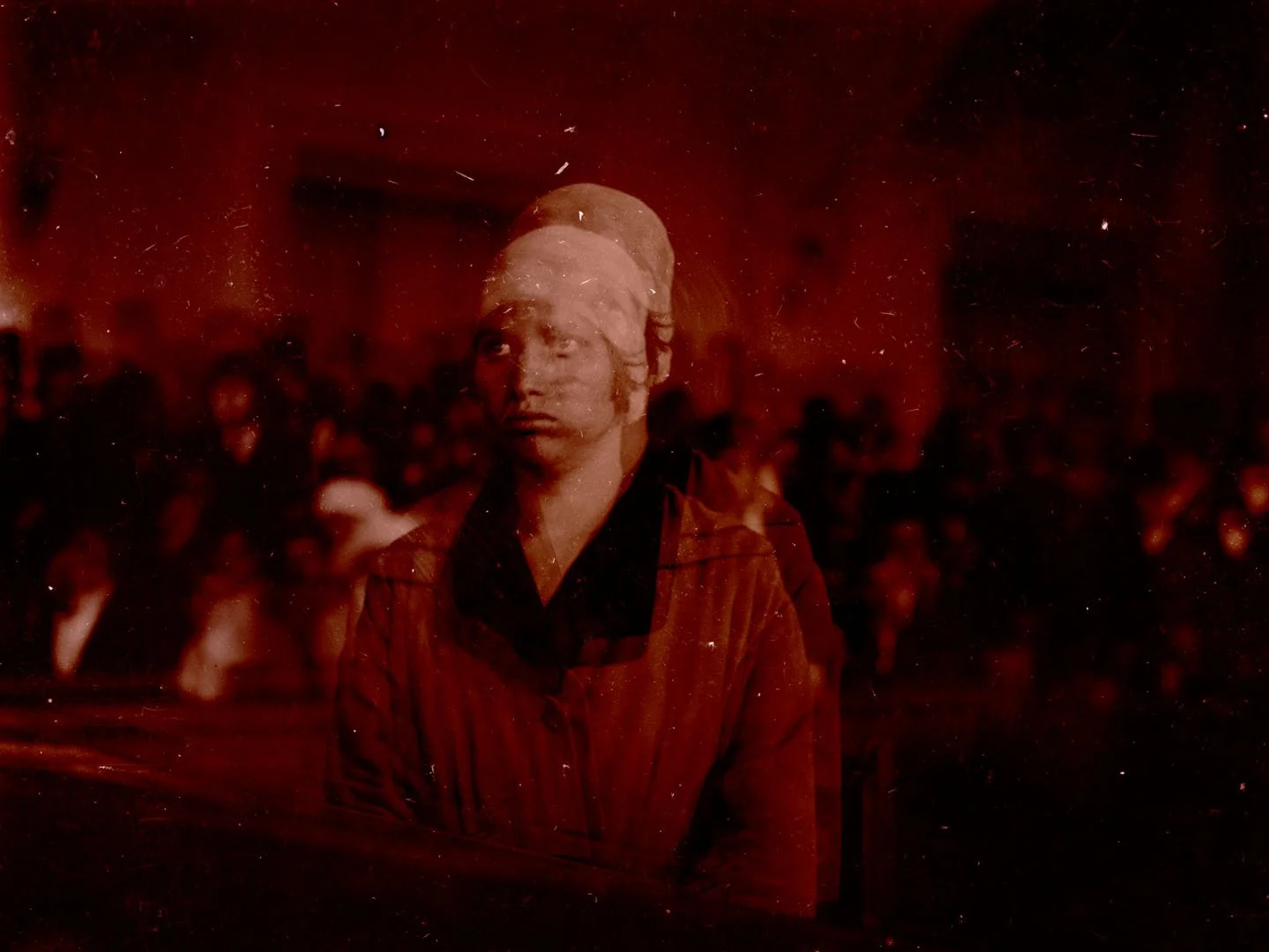
Unidentified courtroom photograph. İstanbul Research Institute Photography Archive.
My research centers on a collection of more than 22,000 photographs, comprising glass and acetate negatives, recently acquired by the Istanbul Research Institute in Istanbul. These are photojournalistic images captured in Istanbul through the 1920s, 30s, and 40s, carefully salvaged and indiscriminately hoarded by the prominent press photographer Selahattin Giz (1914-1994). While many of these photographs were unpublished or unpublishable at the time (because of their technical / aesthetic flaws, insignificance, or politically objectionable content), they provide a unique perspective into the everyday life of underprivileged and marginalized populations of Early Republican Istanbul. Departing from these images of hardship and destitution, my research raises questions about the challenges of archival intervention and the ethics of historical reconstruction.
BIO
Ahmet A. Ersoy is Associate Professor at the History Department at Boğaziçi University, Istanbul. Ersoy works on the history of the Late Ottoman Empire with a special focus on the changing role and status of visual culture in a period of modernizing change. He is the author of Architecture and the Late Ottoman Historical Imaginary: Reconfiguring the Architectural Past in a Modernizing Empire (2015); and with Vangelis Kechriotis and Maciej Gorny, Discourses of Collective Identity in Central and Southeastern Europe (1775-1945), vol. III (2010). Ersoy’s recent research involves the entwined histories of new media technologies (in particular photography) and print culture in the Ottoman domain. His publications include “Ottomans and the Kodak Galaxy: Archiving Everyday Life and Historical Space in Ottoman Illustrated Journals,” in History of Photography, 40/3 (September 2016); and with Mehmet Kentel, “Burnt Panorama: Forensics, Photography, and the 1870 Pera Fire,” in Ç. Kafescioğlu, M. Kentel, B. Tanman, On the Spot: Panaromic Gaze on Istanbul, a History (2023).
Response to Keynote
Deniz Türker, Rutgers University
BIO
Deniz Türker is a historian of Islamic art and architecture, specializing in late-Ottoman visual and material cultures. Her research explores how modern forms of sovereignty and identity were fashioned through emerging representational technologies, architectural practices, and landscape interventions. Türker’s first monograph traces the centurial transformation of Yıldız—the last Ottoman palace in Istanbul—between the 1790s and 1910s. It examines how photography, prefabrication, and artificial landscapes became tools of imperial self-fashioning, while also highlighting the significant roles of women in the Ottoman court and non-courtly contributors in shaping the period’s architectural and garden histories.
Presentation Panels
Panel 1
Erin Hyde Nolan, Bates College
Technologies of Femininity: Cameras, Corsets, and Clocks in the Abdülhamid II Albums
ABSTRACT
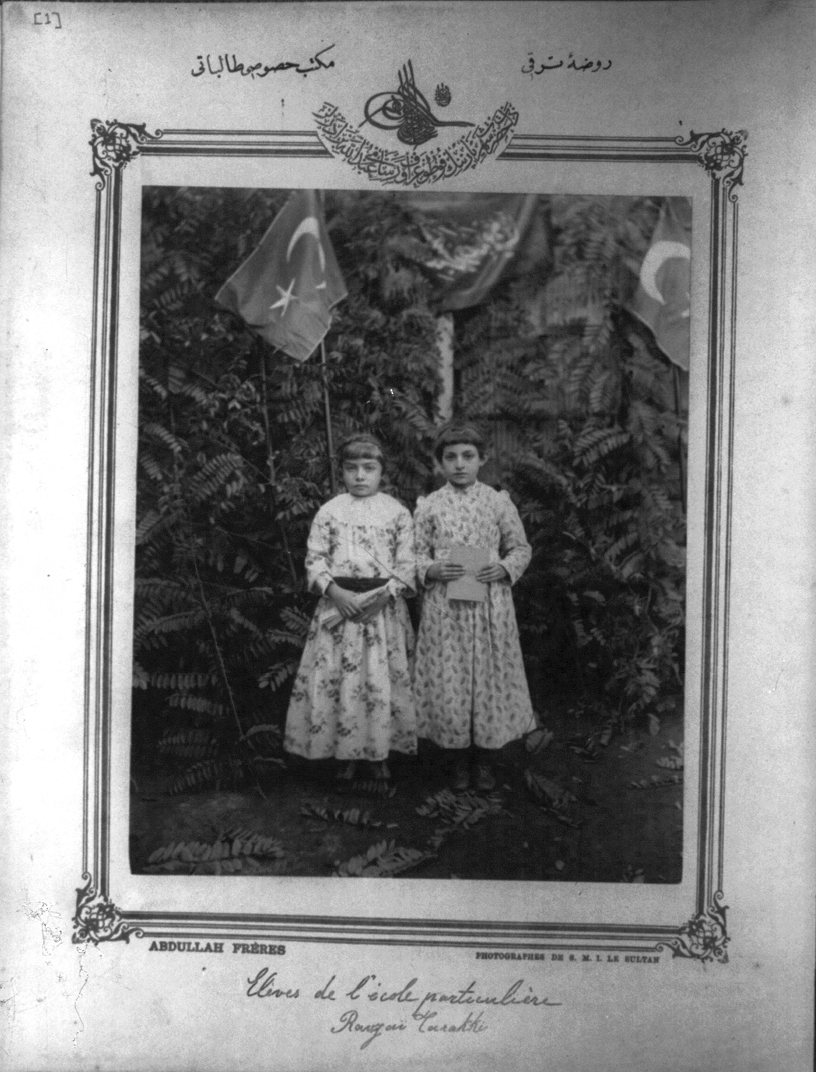
Abdullah Fréres, Students, private school Ravza-yi Terakki, Albumen Print, Lot 9511, Library of Congress Prints and Photographs Division Washington, D.C. 20540 USA
This talk explores technologies of femininity as a fundamental analytic in the history of Islamic art. It maps and analyzes one singular album of Ottoman school girls alongside other gendered photographic spaces in the Abdülhamid II albums to reveal how the camera acted as an agent of authority at work on the body in both the imperial past and in the Turkish present. Together, these photographs visualize the Ottoman female body, picturing how it was shaped by imperial norms, social expectations, and gender standards in the last decade of the nineteenth century. They conceptualize empire and gender together, providing a focused lens through which to view how the two were intertwined and institutionalized. At the same time, the album serves as a teleological device, enforcing, in the case of the court, heteronormative subservience and religious piety from a young age. It documents children through the (pro)creative apparatus of the camera, engineering a vision of empire that includes female bodies, their reproductive potential, and a future citizenry that these bodies might create.
BIO
Erin Hyde Nolan is a historian of lens-based media and visual culture, specializing in the late-Ottoman and modern Mediterranean world. She investigates the cross-cultural circulation of images, exploring the spaces where photographs connect continents, countries, and cultures. Currently, she is a fellow in the Aga Khan Program for Islamic Architecture at Harvard University and a Visiting Assistant Professor at Bates College. Co-author of Survey Practices and Landscape Photography Across the Globe, and she has published in the Routledge Companion to Art and Formation of Empire, Trans-Asia Photography, Ars Orientalis, Reading Objects in the Contact-Zone, and Fotogeschichte. Her archival research has been supported by the Terra Foundation for American Art, Kunsthistorisches Institut in Florenz, and the Getty Research Institute.
Furkan Sarılıcan, Rutgers University
Fashioning the Bektashi Self: Sacred Visibility and Revolutionary Self-Fashioning in the Late Ottoman Empire
ABSTRACT
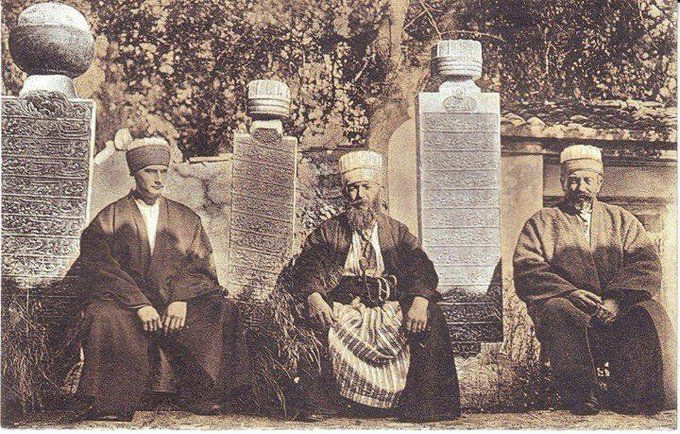
What does it mean for a mystical Islamic order outlawed by the state, mythologized through imperial military history, and filtered through Orientalist lenses to reassert itself visually in an era of political rupture? This paper examines how the Bektashi order, long associated with heterodox mysticism and the Janissaries, navigated suppression and revival in the late Ottoman Empire through a visual culture of negotiated self-fashioning. From the state-orchestrated ethnographic typologies of Les Costumes Populaires de la Turquie (1873) to the Orientalist studio photographs of Pascal Sebah and the self-curated layouts of the Bektashi journal Muhibban, Bektashis engaged multiple visual regimes not simply as passive subjects but as active agents shaping their own image.
BIO
Zeki Furkan Sarılıcan is a 3rd-year PhD student and a Rutgers Presidential Fellow (2023-2026). His research focuses on American missionary enterprise in the Eastern Mediterranean region.
Furkan's academic interests include the architectural representation of American missionaries in the Middle East, the role of missionaries in nation-building in the region, and the socio-cultural and political dynamics of missionary activities in the Eastern Mediterranean and Middle East. Prior to his doctoral studies, Furkan earned his master's degree from Middle East Technical University's Architectural History Department with his thesis titled "Robert College: The Building of an American School in Istanbul, 1863-1977."
Berin Gölönü, University of Buffalo
Postcard imagery of Ottoman (and post-Ottoman) public parks and gardens, 1908-1923
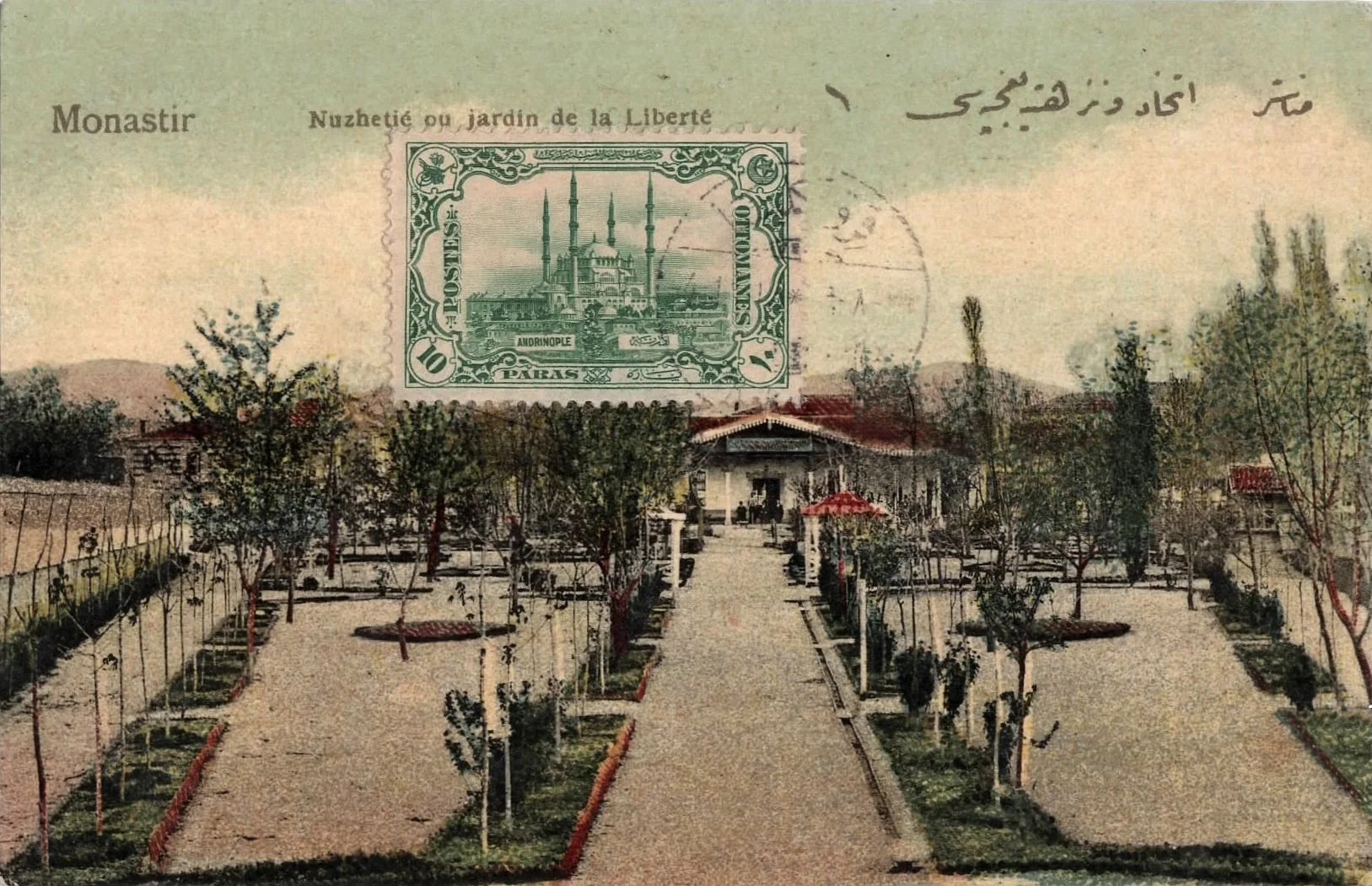
Postcard of the Nüzhetiye Public Garden (Garden of Union and Progress) in Manastır (Bitola), photochrom, postal stamp dated 1913.
ABSTRACT
Ottoman recreation sites are a popular subject in late eighteenth and nineteenth century visual culture. My talk builds upon this historical trajectory to look at early twentieth century postcard imagery of the new Ottoman public gardens and parks that started opening across the empire in the year 1870. Postcard production flourished during the years of the Second Constitutional Monarchy (1908-1920) with hundreds of editors active in dozens of towns and cities across the Ottoman empire. Although the populist appeal of the picture postcard, as well as the accessibility of the gated urban park are up for debate, both were used as vehicles to disseminate emerging (and competing) state ideologies to publics during a period of political crisis. I conduct a close read of the photographic source material, image captions, postal stamps, censors’ stamps, and messages written by the senders of some of these postcards to show how they reflect the changing political regimes, wars, and shifting borders of Ottoman and post-Ottoman lands. Since many of the photographs reproduced on twentieth century postcards date from the late nineteenth century, I ask how these earlier images, and the spatial practices they portrayed, were read and understood over time.
BIO
Berin Gölönü is an Assistant Professor of Art History at the University at Buffalo. Her research focuses on urban ecologies, spatial practices, and landscape imagery. She is currently completing her first monograph titled Naturalizing Modernization: Urban Public Space and Cultural Memory in Late Ottoman Istanbul, which traces changing concepts of urban recreation space in the Ottoman capital during the long nineteenth century. Sections of this research have been published in Yıllık: Annual of Istanbul Studies (forthcoming, 2026), the edited volume Commoning the City: Empirical Perspectives on Urban Ecology, Economics and Ethics (Routledge, 2020), and Infrastructures and Society in (Post) Ottoman Geographies (Forum Transregionale Studien, 2021). Gölönü’s research articles have appeared in peer reviewed publications such as Third Text and the Journal of Visual Culture, and her art criticism has been published in art journals worldwide. Her research has recently been supported by Dumbarton Oaks/Mellon Democracy and Landscape Initiative, the UB Humanities Institute, Getty/ACLS, the American Research Institute in Turkey/NEH, and the Leibniz Research Alliance in conjunction with Zentrum Moderner Orient, among other funding institutions.
Response to Panel 1
Gülru Çakmak, University of Massachusetts at Amherst
BIO
Gülru Çakmak is an Associate Professor specializing in eighteenth- and nineteenth-century French, English, and Ottoman art. She received her PhD at Johns Hopkins University in 2010 under the supervision of Professor Michael Fried with her dissertation entitled Jean-Léon Gérôme: The Innovative Years (1851-1859), for which she was awarded a Distinction. Prior to her doctorate, she received an MPhil degree at the Amsterdam School of Cultural Analysis (Thesis: “Subversive Ambiguities: Disruptions, Self-Representation, and the Role of the Beholder in Paul Cézanne’s Les Grandes Baigneuses (V.721)”), an MA degree with Distinction in Gender Studies at Central European University in Budapest, Hungary (Thesis: “Aesthetics of Subversion: The Uncanny and the Grotesque in Aubrey Beardsley, Hannah Wilke, Mary Duffy, Louise Bourgeois, İnci Eviner”), and an MFA degree at Bilkent University in Ankara, Turkey (Thesis: “The Body Unmasked: The Freudian Uncanny and Kuzgun Acar’s Theatre Masks”). In a highly selective nationwide competition in 2011, Dr. Çakmak was designated a New Faculty Fellow by the American Council of Learned Societies.
Her book Jean-Léon Gérôme and the Crisis of History Painting in the 1850s (Liverpool University Press, 2017) addresses a turning point in French art in the middle of the nineteenth century when traditional history painting lost its status as a compelling mode of representation. Was history painting even feasible in modern times, in a period that witnessed an increasing demand for empirical observation in art, and an emergent modern epistemology that posited the past as foundational yet inaccessible to the physically and historically specific individual? The book demonstrates that Gérôme, typically seen as a conservative academic painter, responded swiftly to the modern sensibility of history and the crisis of historical representation in the 1850s. Embarking on a phase of artistic experimentation, he reflected on the aims and limitations of history painting by devising a quintessentially contemporary art that acknowledged the viewer not as an abstraction but as a historically situated and embodied subject. The first monograph of its kind to present a sustained analytical study of a key decade of Gérôme’s art, the book offers a historical and theoretical understanding of the artist’s work in the 1850s against the background of the modernization of visual culture in France.
Panel 2
Zeynep Devrim Gürsel, Rutgers University
Exile and Emigration: Photographic Subjects During the Hamidian Era
ABSTRACT
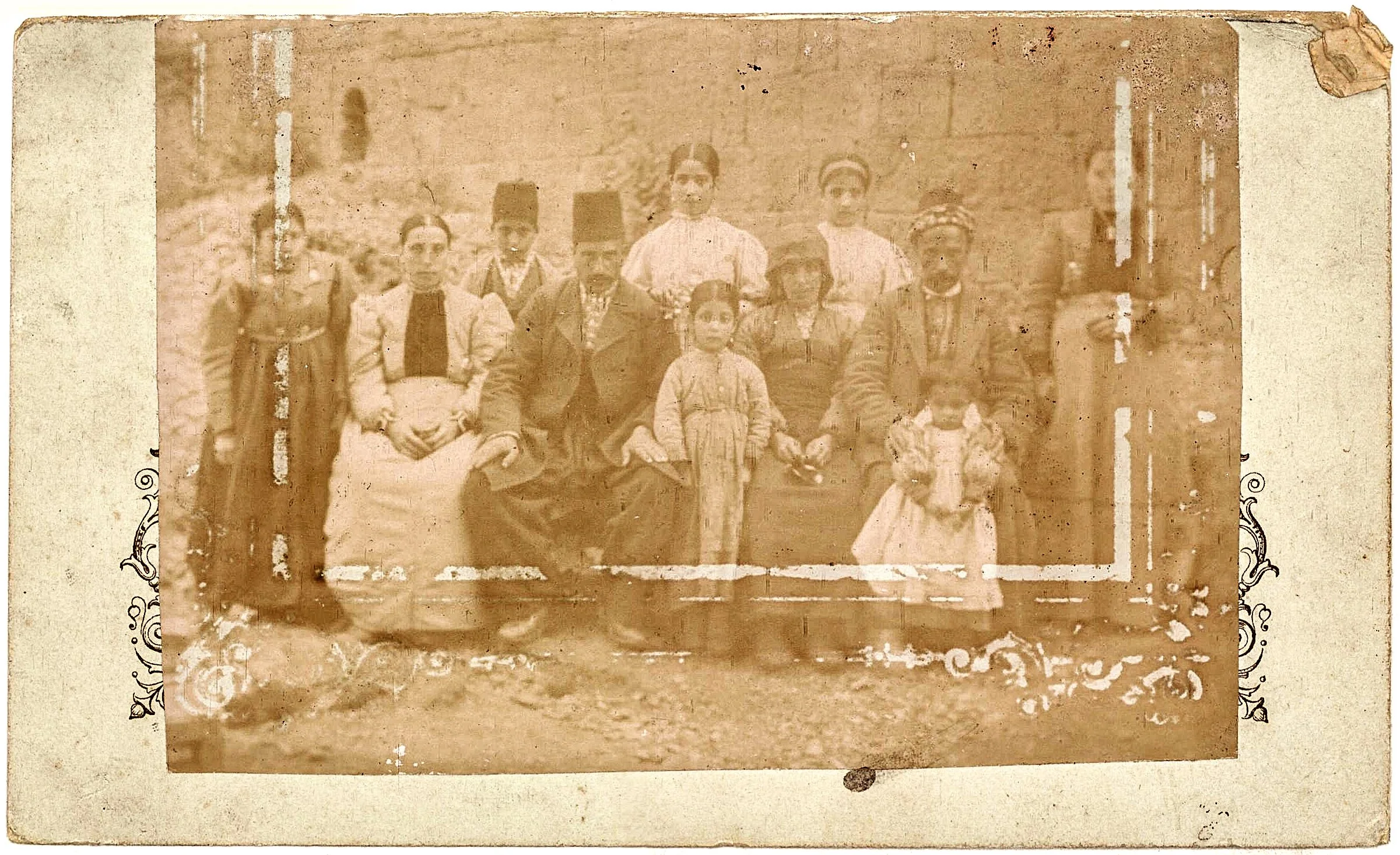
1907 Terk-i Tabiiyet Photograph of the Simonian family from Bitlis, bound for Fresno. Courtesy of Başbakanlık Osmanlı Arşivleri (Prime Ministry Archives, Istanbul)
What can photography reveal about political representation? Under what circumstances were individuals brought into photographic visibility for the state? This talk “watches” two moments of photography in the Ottoman Empire and considers a sovereign's gaze at a time when constitutional monarchy had been introduced but suspended.
BIO
Zeynep Devrim Gürsel is a media anthropologist and Associate Professor of Anthropology at Rutgers University. She is the author of Image Brokers: Visualizing World News in the Age of Digital Circulation (University of California Press, 2016) and Portraits of Unbelonging: Photographic Journeys Across Borders (Stanford University Press, 2026).
Selin Aran, Rutgers University
Antiquities, Soldiers, and the Nile: Photographs from Hidiv Tevfik's 1890 Voyage
ABSTRACT
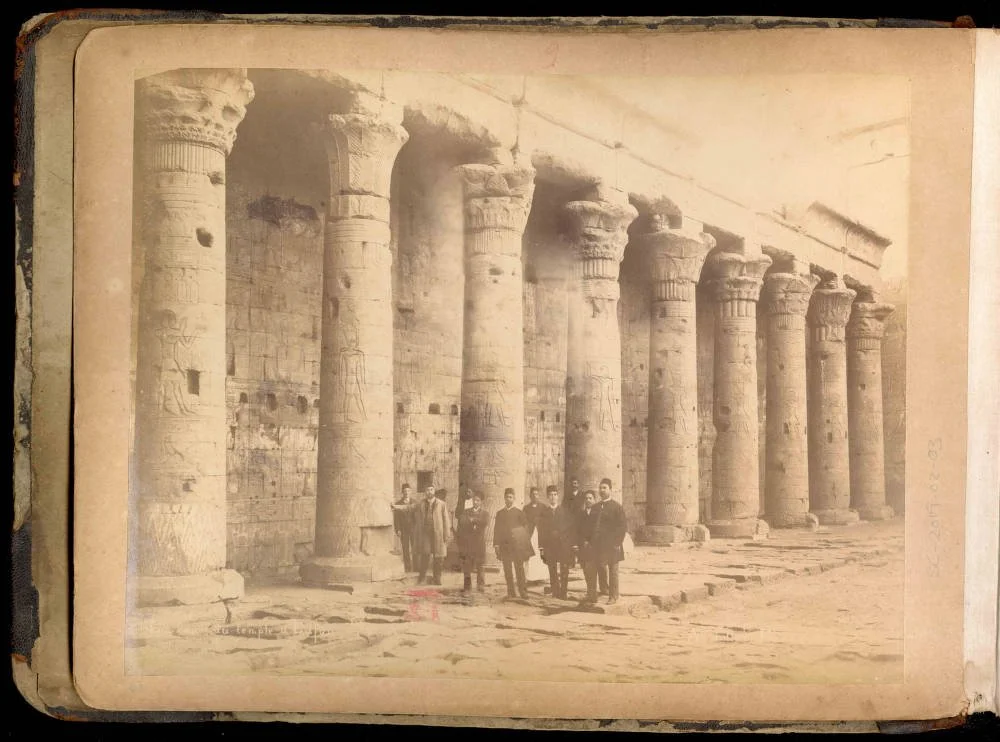
His Majesty Khedive Tewfik at the inner court of Edfu Temple, 1890-1899.
This presentation introduces a photographic album in the American University in Cairo collection, attributed to Ottoman Armenian photographer Kevork Abdullah of the Abdullah Frères studio and documenting Hidiv Tevfik’s 1890 Nile voyage. The album brings together views of major pharaonic sites with images of soldiers and military parades. The grouping invites consideration of how late nineteenth-century photographic albums could create a curated image of national identity in which Egypt appears as both heir to ancient grandeur and a resilient military power during a period of contested sovereignty.
The presentation considers how such an album operates within Egypt’s precarious political condition after 1882, shaped by overlapping claims of Ottoman suzerainty, British control, local assertions of autonomy, and khedival authority. Attention is given to sequencing and apparent later additions in order to explore how photography may have participated in negotiating Egypt’s layered pasts and present claims. The material is presented as work in progress, with an emphasis on opening interpretive questions about the album’s visual structure and political resonances rather than fixing its meanings.
BIO
Selin Aran is a PhD student in Art History at Rutgers University–New Brunswick. Her research focuses on the visual culture of the Ottoman Empire and the Middle East in the nineteenth and early twentieth centuries, with particular attention to the history of photography, archaeology, and Orientalism; examining both image-making within the region and its representation from without.
Response to panel 2 with Discussion and closing remarks
Alex Seggerman, Rutgers University
BIO
Alex Dika Seggerman is associate professor of Islamic art history. She specializes on the intersection of Islam and modernism in art history.
Her first book, Modernism on the Nile: Art in Egypt between the Islamic and the Contemporary (UNC Press, 2019), traces the arc of Egyptian modernism in art, arguing that artists confronted and visualized the transnational context of their circulation through a “constellational modernism.” She made over a hundred images of modern Egyptian artwork available on JSTOR as well as published an open-access companion essay and image collection in MAVCOR. She delivered lectures about her book around the world, including at William & Mary, Boston College, NYU, and in Beirut.
Her second book, Making Modernity In the Islamic Mediterranean (Indiana University Press, 2022), is a co-edited volume that repositions major changes in nineteenth century Islamic art as the result of transformative political, technological, and market shifts. The volume includes a chapter by Dr. Seggerman that analyzes the impact of reproducible image technologies, from engraving to photography, on Cairo’s Muhammad Ali Mosque (1830-48).
Dr. Seggerman’s next book project, Art Histories of American Islam, has been supported by the Center for Advanced Study in the Visual Arts, the Smithsonian American Art Museum, and the National Museum for Asian Art. The project examines the long history of Islam and art in America, from the 17th century until today. This research includes portraits of enslaved Muslims, material culture of early Ottoman Arab immigrants in the American midwest, and the work of contemporary artists Ghada Amer, Shirin Neshat, and Shahzia Sikander at the turn of the twenty-first century.